Company: Nill
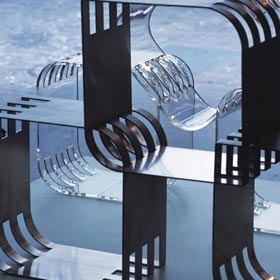
Exhibit Name: Show Off- a display unit for objects (part of the LOX BOX range of Designs)
Design Intent: The desire to create the SHOW OFF range was sparked by two different observations of trends occurring in society relating to design:
1."Out with the old and in with the new". This seems to be something we are hearing much too often in recent times through the "renovation boom". This attitude is encouraging a throw away society. Why can't we design to last?
2.Current trends are encouraging us to create sleek uninterrupted lines within our interiors. Objects that are important to us are now being labelled as "clutter" as we have nowhere to put them. My aim was to create a unique display system that we can proudly "show off" our loved possessions.
This led me to look at what is kept and why, and how can we display our loved objects?
Description: LOX BOX is a connection method designed to allow for easy adaptable arrangements of modular units. The SHOW OFF display system is part of the LOX BOX series of designs, designed by Amy Cunningham. This adaptable range of modular display units interlock through their slotted form. Inspired by the interlocking of human hands, the design aims to connect the user with the object displayed, through their interaction and input into the modules' arrangement. This reference to human contact and interaction in the design, embodies one of the major features of the kept object, that being connection. Connection with the past, history, memories, loved ones, other places etc. This connection to these elements of our past is represented through the objects we keep, display and conceal.
The user connects with the SHOW OFF pieces through the adaptability of the designs' options for use and arrangement. The range allows the user to choose the elements they require to fulfil their display/ shelving and/or screening needs for their space. More pieces can be added over time or used in different environments to fulfil different function allowing the design to in itself embody the adaptable and therefore lasting nature of kept objects.
The adaptability of the designs' options for use and arrangement allows the user to choose the elements they require to fulfil their display/ shelving, concealing and/or screening needs for their space. More pieces can be added over time or used in different environments to fulfil different functions allowing the design to embody the adaptable lasting nature of kept objects. The design allows for a multiple of applications of use, stand alone display unit, wall mounted display, screen/room divider, inbuilt display into the architecture. Other possibilities for the design have presented themselves with further additions to the range. The design also allows for different material and manufacturing options with only small changes needing to be made.
Further development of the series has been undertaken with the options for concealment of small objects within secret compartments and pin pieces to further stability and increase the number of options in arrangement. Further developments in material and form utilising the LOX BOX interlocking feature is currently being explored.
Production: Each Individual component is for the wide unit- 400mm x 400mm x280mm & for the narrow unit- 400mm x 400mm x200mm. The Prototypes have been developed in three different shapes and materials all lending themselves to different manufacturing and construction methods:
Firstly the square shape has been produced in plywood. This is formed by, laser cutting the slots into the flat piece of ply. Then the flat piece is cut into 4 pieces through the middle of the slots on 45 degree angels. These 45 degree edges are then folded up together to make a box and Fixed with glue. They are then sanded and finished with gloss vanish.
The Curved boxed are made in Acrylic. These are also laster cut flat to create the slots. These pieces are then heat bent around a specifically formed mould. The ends are heated together at the base.
The Squrve (half Curve half Square shape) are made out of Aluminium. They are also laser cut but in tow halves. The two halves are then formed with a 10 cm radius curve in the middle creating the curve corners. The end are kept straight and are spot welded together to create the square corners. They are then glass bead blasted to give them a texture finish, but they could be powder coated also.
Thus far these designs are only in prototype stage. I have been working with three different manufactures to get them produced to this level. The production level thus far is 8 pieces of timber, 9 pieces of acrylic and 3 pieces of aluminium. The possibility to increase the production run is there with the manufactures, but I would require funding or un upfront order and payment to get this off the ground.
Each shape lent itself to different materials. Each process has its similarities and differences. I chose them materials that would produce the desired shape in the most simple production method possible and for a cost effective sum. The Production process would remain as simple for larger runs, with the unit price decreasing rapidly as the volume increases.
The Timber units were created by a cabinet maker who utilised laser cutting technology. The Acrylic where produced by a plastic fabrication company who normally create retail displays in Acrylic. The Aluminium were created by an Aluminium engineering company. These manufactures were chosen as they were willing to work with a student and do small runs and may not be ideal for larger scale production. I am currently investigating options for larger scale production.
Market: I believe my SHOW OFF Display System design would be suited to a variety of markets as it's versatility of options in shape and material can transforms the designs aesthetic without changing the function of the design. The designs lend themselves to both domestic and commercial applications, with possibilities of display in retail and hospitality spaces being just as valid as in a domestic space.
The acrylic curve design takes a modern, fun and playful approach, and can be produced in a variety of colours and finishes.
The square Plywood is classic, stylish and has a very European essence.
The Aluminium shape is a hybrid of the other two shapes Curve and square creating the name Squrve. This design creates beautiful patterns when slotted together and is interesting to the eye.
I am investigating further developments to the material possibilities as well as additions to the product family such as corner blocks allowing the units to wrap around corners or slot into a corner of a room.
I will firstly be aiming the design at the domestic market and looking other material options and scales of sizes for more commercial applications.
You should know: As a designer, I believe above all in function and adaptability in design. I create designs that I feel fulfil a need. I feel very passionate about my research of the kept object in which I have been investigating individual's connection to their retained objects. The question I ask is, why are we connected to certain things and can we adapt this knowledge to modern design?
I felt drawn to the 3 dimensional object whist undertaking my degree in Design, before this I was a very graphic based designer. Once I had been shown the wonderful possibilities of thinking and designing in the 3rd Dimension there was no turning back I was hooked! Furniture design became my focus and my passion through observing my family's close connection to furniture in there lives, in particular a my Grandmother's daybed which holds such strong memories for all the family. This close connection to a useful object became a fascination of mine and sparked me to investigate our connection to the significant objects that surround us.
|